
Linear vibrating screen is mainly driven by two synchronous and reverse vibration motors. The directional exciting force is synthesized to make the material jump and move linearly on the screen surface, so as to achieve efficient classification and impurity removal.
Equipped with two same-type vibration motors rotating synchronously in opposite directions, the equipment has eccentric blocks installed at the shaft ends. During rotation, the centrifugal force generated by the eccentric blocks cancels each other out in the direction parallel to the motor axis, and superimposes into a single-direction linear resultant force in the vertical direction, driving the screen box to vibrate reciprocally along a straight line. A certain inclination angle is set between the motor shaft and the screen surface, providing a driving force for the forward movement of materials.
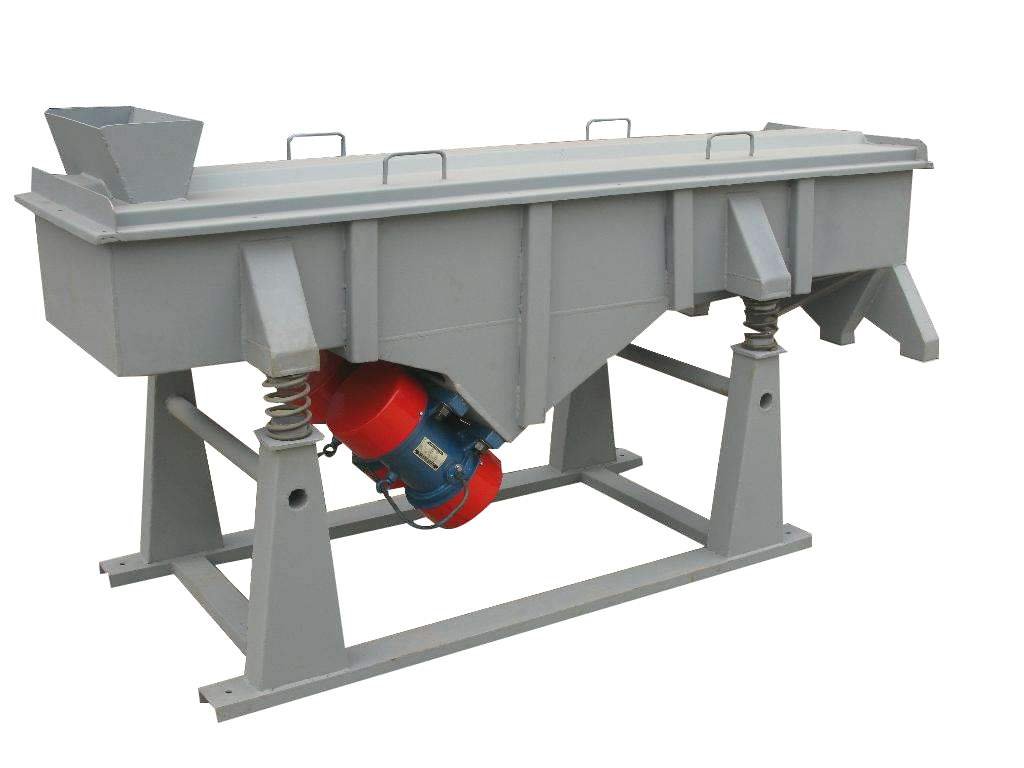
Materials are evenly fed into the feed port and then thrown vertically under the combined action of exciting force and gravity. They jump forward on the screen surface in a parabolic trajectory. During continuous tossing and falling, materials are continuously loosened and layered. Fine particles smaller than the screen holes penetrate the screen mesh and become under-screen products, while coarse particles larger than the screen holes move along the screen surface and are discharged from the end discharge port as over-screen products.
The screen box is welded with high-strength steel plates and supported by shock-absorbing springs, ensuring stable operation and low vibration to the foundation. The multi-layer screen design allows multi-specification material screening at one time, suitable for food, chemical, mining and other industries. The fully enclosed structure prevents dust overflow, and automatic discharging matches assembly line operation, featuring high efficiency, low energy consumption and easy maintenance.