
A screw conveyor is a piece of equipment that achieves continuous material conveying through the rotation of a helical screw. It is widely used for horizontal, inclined or short-distance vertical conveying of powder and granular materials in industries such as chemical engineering, grain, building materials and mining.
Its core working principle relies on the interaction between helical blades and materials. The equipment mainly consists of a driving device, screw shaft, helical blades, casing, inlet and outlet. During operation, the motor drives the reducer to rotate, transmitting power to the screw shaft and making the helical blades rotate at a constant speed.
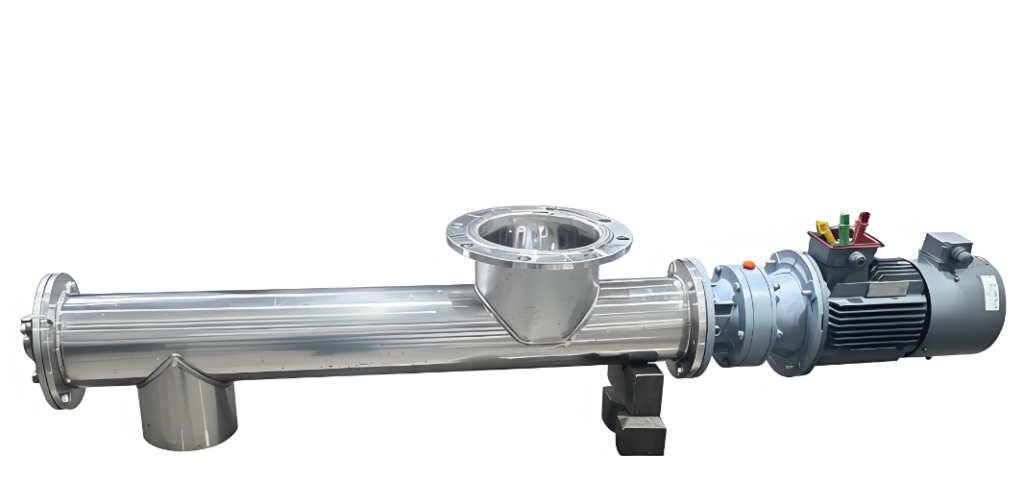
After materials enter the casing from the inlet, they cling to the bottom due to their own gravity and are subjected to axial thrust and tangential force generated by the rotating blades. Since materials cannot rotate synchronously with the shaft, they are pushed forward along the inner wall of the casing under continuous axial thrust and finally discharged from the outlet, completing the conveying process.
The fixed U-shaped or tubular casing restricts circumferential movement to prevent materials from rotating with the shaft. Horizontal conveying mainly depends on axial thrust, while inclined conveying requires overcoming gravity, thus needing higher torque and speed. Pitch, diameter and rotation speed directly determine conveying efficiency, which can be adjusted according to material properties and throughput to ensure stable, enclosed conveying and reduce dust emission.