
Vibrating screen is a piece of equipment that realizes material classification, impurity removal and screening by means of vibration force. Its core lies in generating directional vibration through an excitation device, so that materials can be layered and screened on the screen surface. During operation, the motor drives the eccentric block or exciter to rotate at a high speed, producing periodic excitation force, which makes the screen box perform reciprocating or rotary vibration along a specific direction.
Materials fall evenly into the middle of the screen surface from the feed inlet, and keep loose, bounce and move forward under the action of vibration. Fine particles smaller than the screen holes pass through the screen smoothly under the influence of gravity and vibration force, becoming under-screen products; while coarse particles larger than the screen holes cannot penetrate, and slide along the screen surface to the discharge end as over-screen products, thus completing the separation of coarse and fine materials.
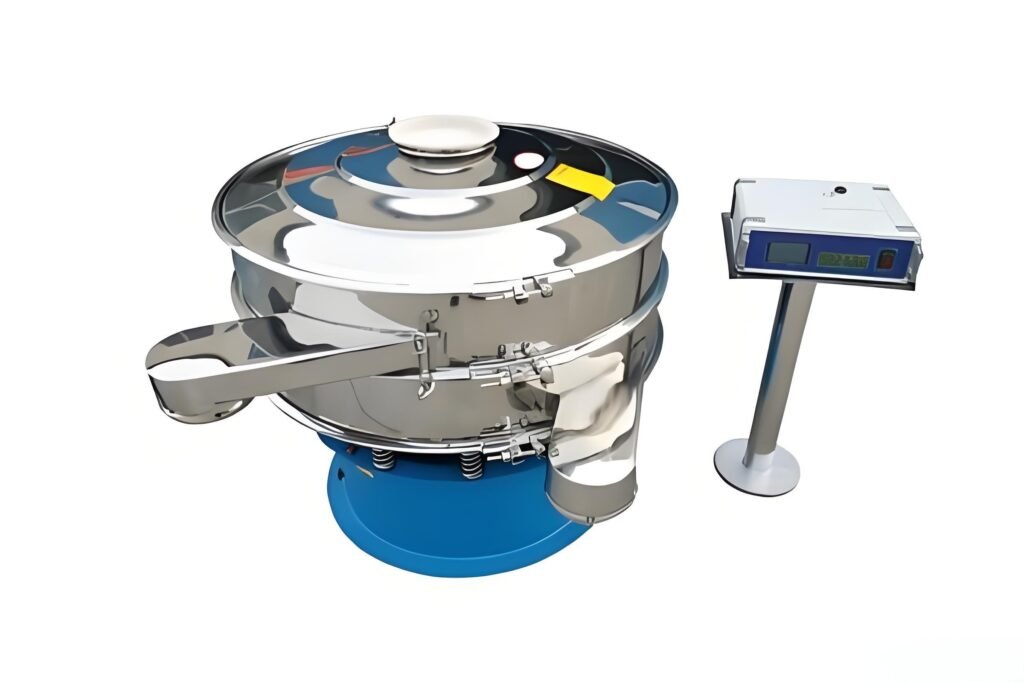
To ensure screening effect, the vibration direction forms a certain angle with the screen surface, which not only pushes materials forward, but also prolongs the contact time between materials and the screen mesh, reducing screen blockage. Different types of vibrating screens have slightly different principles: linear vibrating screens mainly rely on linear reciprocating vibration force with high screening efficiency, suitable for large-batch material processing; rotary vibrating screens perform circular motion, with more uniform material dispersion, mostly used for fine screening.
The whole machine realizes continuous operation by vibration without complex extrusion or rolling, featuring simple structure and low material damage. It is widely used in particle classification and impurity filtration in mining, building materials, grain, chemical industry and other industries, serving as an efficient and stable screening equipment in industrial production.
