
Adding dust‑free feeding stations onto the existing centralized feeding pipelines addresses pain points such as dust emission, material waste and dust pollution caused by manual bag‑opening and feeding. Large‑scale dismantling of original pipelines is not required, resulting in high cost‑performance for the retrofit. The overall retrofit follows the principles of maximum reuse of existing facilities, sealed conveying, explosion‑proof compliance and phased construction. The complete retrofit solution consists of five modules: layout planning, equipment selection, pipeline connection, dust removal & risk control, as well as construction and commissioning.
Combined with the two mainstream forms of existing centralized feeding systems, namely vacuum conveying and pneumatic conveying, on‑site survey shall be carried out first. Mark the routing of main conveying pipelines and branch pipelines, as well as positions of fans, silos and buffer tanks one by one. Determine installation positions for dust‑free feeding stations according to the feeding demand of each production line. Priority shall be given to installation at the connection area between raw material warehouse and production line, away from electric control cabinets and high‑temperature equipment. Reserve space for maintenance, forklift unloading and ton‑bag hoisting operation. Keep a passing distance of more than 1.5 meters between adjacent stations. For multi‑station layout, connect all stations to the central dust‑removal main pipe to avoid mutual interference from dust overflow at multiple points. For small‑bag powder materials, adopt standard small‑bag dust‑free feeding stations. For ton‑bag raw materials, adopt integrated ton‑bag dust‑free feeding stations. Equipped with built‑in vibrating sieve for impurity removal, the equipment intercepts agglomerates and bag fragments to prevent blockage and abrasion of downstream vacuum pumps and conveying pipelines.
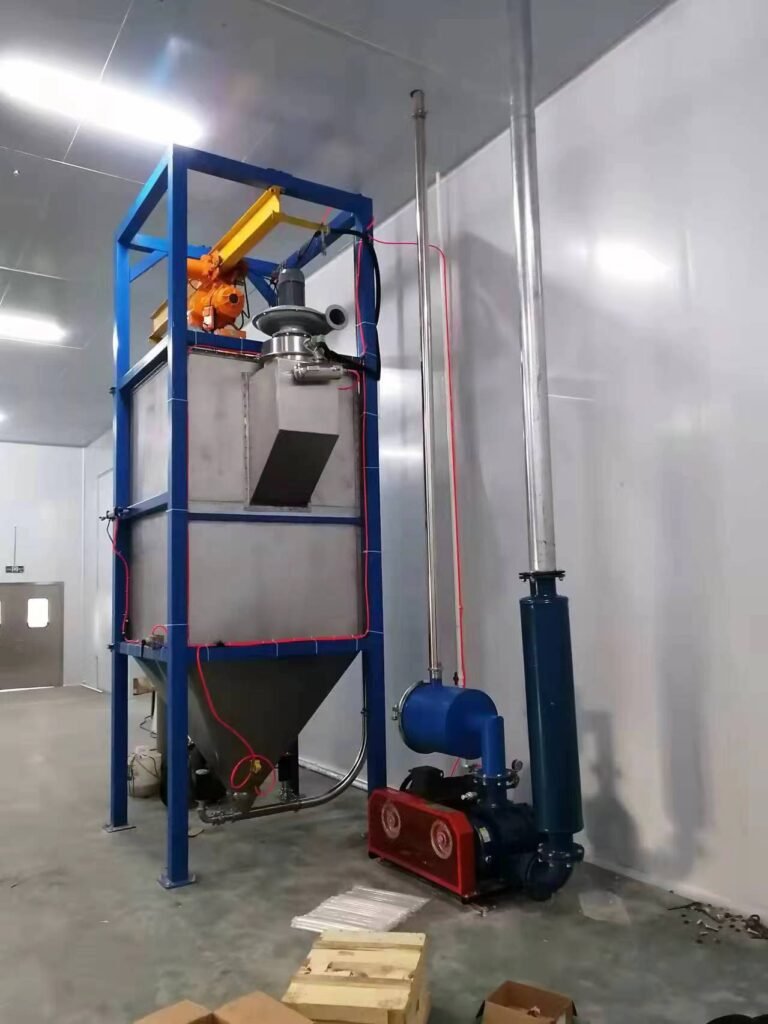
Pipeline connection constitutes the core of retrofit. Hot‑work hole‑opening on operating main pipelines is strictly prohibited. Construction shall be arranged during production‑line shutdown‑and‑maintenance windows. Shut off original gas‑supply and feeding valves, and empty residual powder inside pipelines. Branch pipelines shall be diverted from the front‑end of the negative‑pressure buffer bin of the centralized feeding system, equipped with manual ball valves, butterfly valves and check valves to prevent material backflow which may contaminate feeding stations. The discharge port of the feeding station is hermetically connected to newly‑added branch pipes via flexible connectors. Silicone gaskets shall be installed at all flange joints to form a fully sealed conveying channel for the whole branch. If the existing central dust‑removal system has sufficient surplus air volume, connect the dust‑collection ports of feeding stations to the original plant dust‑removal pipe network. If air volume is insufficient, install independent pulse filter‑cartridge dust collectors to capture diffused dust the moment bags are opened, so that workshop dust concentration meets environmental‑protection emission standards.
Electrical and safety supporting facilities shall be upgraded simultaneously. Local start‑stop buttons shall be configured for vibrating motors and dust‑removal fans of feeding stations, with signals connected to the original central‑control system of the production line to realize start‑stop linkage and fault alarm. For flammable and explosive powder materials, the complete set shall adopt explosion‑proof motors, anti‑static pipelines and static‑grounding devices. All equipment shall be uniformly grounded to eliminate fire risks caused by static‑electric accumulation. Anti‑static floor shall be laid in feeding areas, and labor‑protection articles including anti‑static gloves and dust‑proof masks shall be provided.
Segmented operation is adopted during construction: fix equipment bases and lay pipelines first, then perform air‑tightness pressure test. After no powder or air leakage is confirmed, conduct 2‑hour no‑load trial operation, followed by step‑by‑step material‑loaded commissioning. Adjust makeup‑air volume, screening amplitude and conveying air velocity to match conveying parameters of the original centralized feeding system. Establish daily maintenance regulations after retrofit completion, including regular filter‑cartridge cleaning and sealing‑component wear inspection. Without modifying the core conveying system of the old production line, this retrofit thoroughly solves excessive dust emission, raw‑material loss and occupational‑hazard risks induced by open feeding, and improves cleanliness and automatic management level of the entire centralized feeding system.