
Relying on the core advantages of negative-pressure closed conveying, high efficiency and wear resistance, vacuum loaders have become core equipment for conveying powder and granular materials in the building materials industry. They are widely applicable to bulk, highly abrasive and dusty materials such as cement, gypsum, fly ash, ceramic raw materials and sand aggregates, driving the upgrading of building materials production toward environmental protection, automation and high efficiency.
Building materials feature complex material properties. Powders including cement, lime and gypsum powder are fine and prone to flying, while sand and ceramic particles are highly abrasive. Traditional manual handling and screw conveying suffer from severe dust pollution, low efficiency, massive material loss and frequent equipment clogging and damage. Meanwhile, the harsh high-temperature and dusty workshop environment imposes strict requirements on equipment stability. Working on the negative-pressure suction principle, vacuum loaders consist of a vacuum pump, suction pipeline, storage hopper, discharge valve and control system. The fully closed conveying eliminates industrial pain points at the source.
In core application scenarios, vacuum loaders meet the full-process production demands of building materials. In cement production, they convey raw meal powder and finished cement for loading, with a single unit capable of transporting several to dozens of tons per hour to support large-scale production. During gypsum product processing, they deliver gypsum powder to mixers and forming machines dust-free, avoiding dust contamination and material waste. For ceramics, they transport feldspar, quartz, kaolin and other raw materials; closed conveying prevents impurity intrusion and guarantees raw material purity. Besides, for fly ash discharging, mineral powder conveying and sand aggregate transfer, vacuum loaders can replace forklifts and manual labor to deliver efficient, dust-free operation.
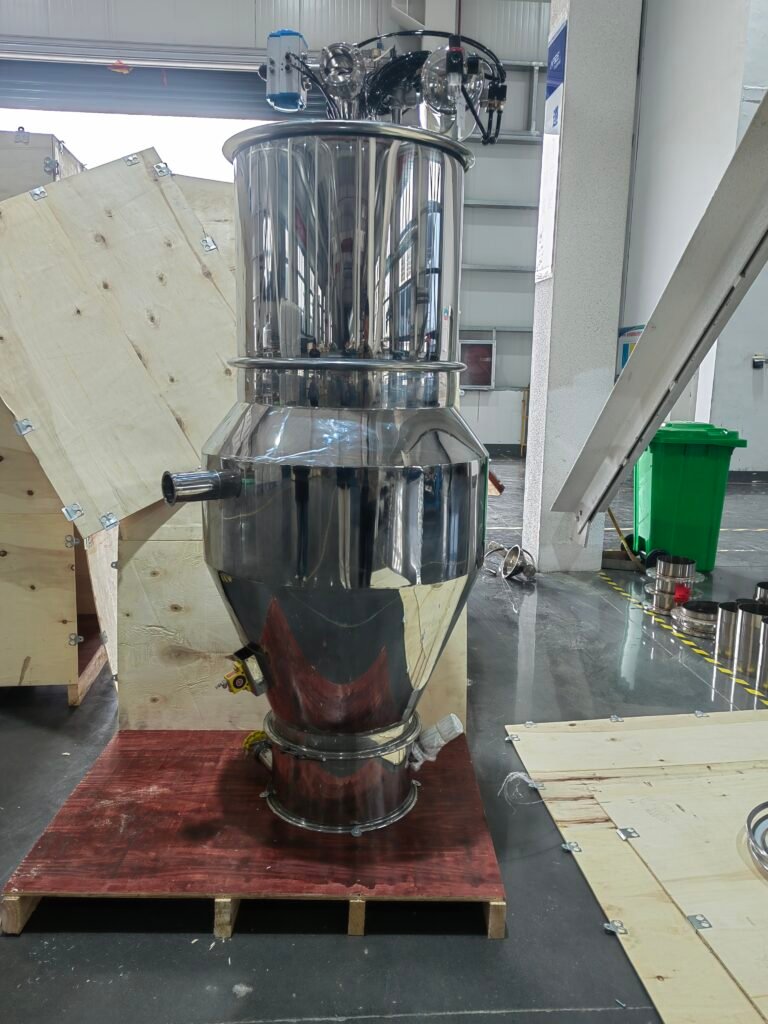
Customized designs are adopted to cope with the high abrasion and dust of building materials. Parts in contact with materials are made of high-strength materials such as wear-resistant steel and rubber lining to resist material impact and extend service life. Equipped with a pulse dust removal device, the fully closed conveying system realizes zero dust leakage, keeping workshop dust concentration within standard limits, optimizing working conditions and complying with environmental regulations. With a robust structure, the equipment operates stably and reliably under high-temperature and dusty working conditions.
In terms of economic benefits, vacuum loaders help building materials enterprises cut costs and boost efficiency. Automated operation minimizes manual involvement, reducing labor intensity and labor costs. Closed conveying drastically lowers material loss to below 0.2%, saving raw material expenses. High-speed conveying improves production continuity and output. Meanwhile, the equipment boasts low failure rates and easy maintenance, cutting operation and maintenance costs.
In conclusion, with core strengths of environmental friendliness, high efficiency, wear resistance and automation, vacuum loaders perfectly match the production needs of the building materials sector. They serve as vital equipment for manufacturers to achieve green production and automated transformation, possessing broad application prospects.