
Screw conveyors, also known as augers, feature a compact structure, excellent tightness and wide adaptability. They have become core equipment for transporting powder, granular and small lump materials in the chemical industry. Widely used in the whole processes including raw material transfer, process connection, finished product packaging and waste disposal, they provide crucial support for safe, efficient and eco-friendly chemical production.
Most chemical materials are corrosive, flammable, explosive, toxic and volatile. The sealed tubular or trough structure of screw conveyors fundamentally solves the problems of dust leakage and harmful gas escape found in traditional conveying equipment. Equipped with a dual sealing system combining mechanical seals and packing seals at the shaft ends, the conveyors achieve a low leakage rate, effectively stopping the diffusion of hazardous substances such as ammonia gas and acid-base vapor. This not only ensures workplace safety but also meets environmental emission standards. For instance, sealed screw conveyors prevent dust pollution and ammonia leakage during the transportation of urea and phosphate fertilizer in chemical fertilizer plants. When conveying dye intermediates and resin powder in fine chemical production, the sealed structure protects materials from damp deterioration and cross-contamination.
In terms of process adaptability, screw conveyors can be customized according to material properties. For strong acid and alkali materials, 304/316 stainless steel or anti-corrosion coatings are adopted to resist chemical erosion. For sticky and agglomerating materials, variable-pitch blades or auxiliary cleaning devices are installed to reduce material adhesion and blockage. When handling flammable and explosive materials such as coal powder and organic solvent particles, explosion-proof motors and earthing protection are fitted to comply with explosion-proof standards and eliminate risks of static sparks. Meanwhile, the equipment can be installed horizontally, inclinedly or vertically to flexibly fit complex factory layouts. It connects reactors, dryers, storage tanks and packaging machines to realize automatic material transportation and cut down workers’ exposure to hazardous materials.
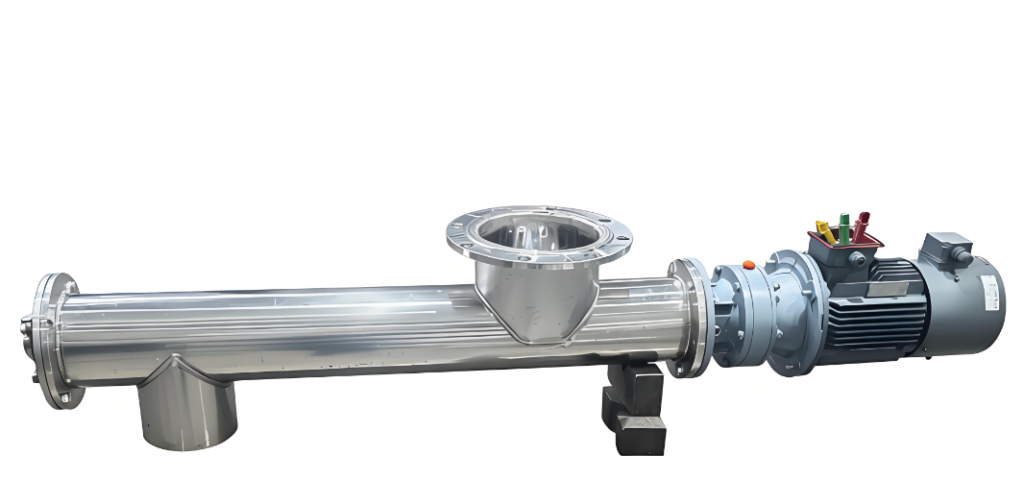
Beyond simple conveying, screw conveyors integrate multiple processing functions to break the limits of single transportation. Some models are equipped with jacket temperature control structures to heat, cool or pre-dry materials during conveyance. Taking ammonium phosphate transportation as an example, synchronous drying reduces energy consumption in subsequent procedures. Precise rotational speed control enables uniform feeding and metered conveying, stabilizing material ratios in downstream reactors and avoiding product quality fluctuations caused by unstable material supply. Moreover, the equipment boasts easy maintenance and low energy consumption, greatly cutting operating costs compared with pneumatic conveying and satisfying chemical enterprises’ demands for cost reduction and efficiency improvement.
In conclusion, screw conveying technology is deeply integrated into all links of chemical production. With core strengths including safe sealing, corrosion and explosion resistance, flexibility and high efficiency, it addresses various bottlenecks in chemical material transportation. As key machinery enabling continuous, automatic and green chemical manufacturing, screw conveyors enjoy broad application prospects.
