
As an efficient laboratory sieving equipment, the tap sieve adopts a compound motion mode combining horizontal rotation and vertical tapping. It perfectly solves the pain points of fine powder agglomeration and screen blocking prevalent in the chemical and powder industries. Serving as core equipment for particle size analysis, quality control and process optimization of materials, it is widely used in sieving testing and classification of chemical raw materials, pigments and dyestuffs, plastic powder, chemical fertilizers, pesticides and other materials.
In the chemical industry, tap sieves accommodate diverse material properties, with application scenarios covering raw material inspection, process monitoring and finished product testing. For granular chemical products such as fertilizers and pesticides, it realizes precise classification and impurity removal, ensuring particle uniformity meets production standards and improving product solubility and application performance. For fine powders including pigments, dyestuffs and additives, the combined motion of high-frequency tapping (approximately 156 times per minute) and rotary shaking (approximately 290 times per minute) can effectively break up agglomerated particles and prevent screen clogging. It guarantees accurate particle size distribution data and delivers reliable reference for color matching and dispersibility optimization. During the processing of polymer powders like plastics and rubber, it detects the particle size composition of resin powder and rubber powder, screens out unqualified coarse particles, stabilizes subsequent processes such as extrusion and injection molding, and improves finished product quality.
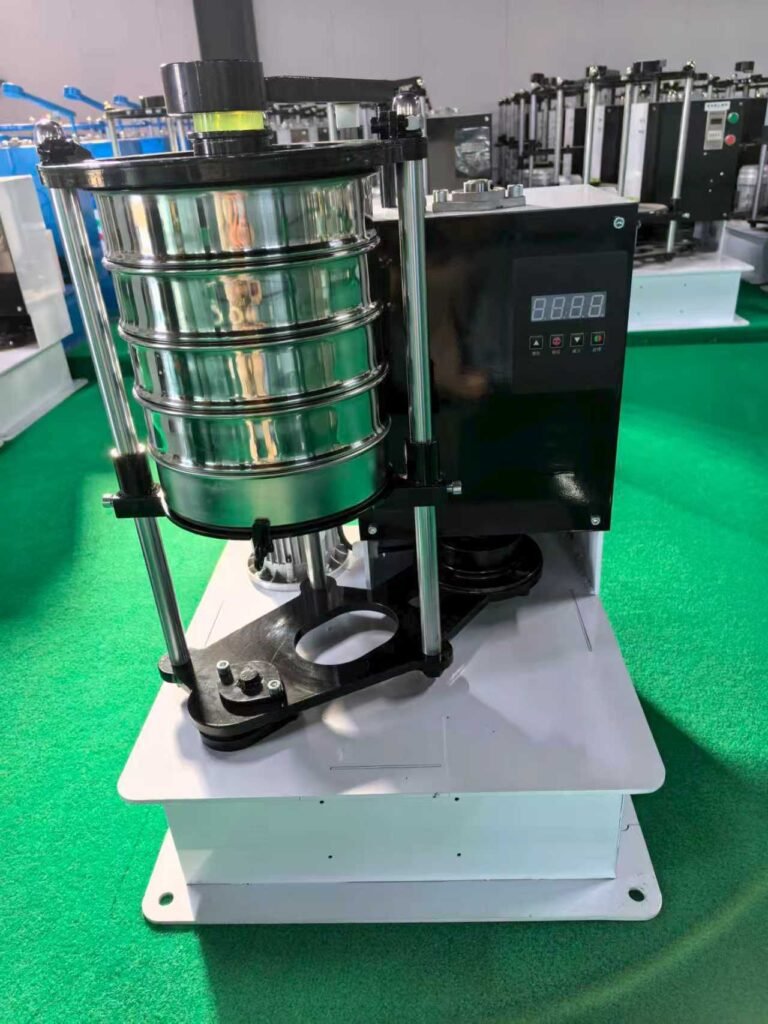
In the powder industry, tap sieves are standard equipment for particle size analysis of quartz sand, heavy calcium powder, kaolin, metal powder and other materials. Such materials tend to stick together and block screens due to static electricity and humidity, resulting in low efficiency of traditional vibrating sieves. Through periodic vertical tapping, tap sieves shake off particles stuck in meshes forcibly to achieve high-efficiency sieving. Meanwhile, the equipment can be fitted with 304/316 stainless steel screens and sealed structures to meet dust-proof and anti-corrosion requirements. It fits the production scenarios of high-purity powder and avoids material contamination. Furthermore, the intelligent timing control (1–99 minutes) and automatic shutdown function of tap sieves ensure repeatability of sieving tests, providing accurate data support for adjusting powder production process parameters, product grading and trade settlement.
Compared with traditional sieving equipment, tap sieves boast prominent advantages. The compound motion design raises sieving efficiency by over 30%, enabling faster feeding and more thorough separation. The precise gear synchronous belt transmission eliminates speed loss and guarantees consistent motion in every sieving run. Featuring a compact structure and easy maintenance, it requires no oil lubrication and suits clean production environments.
In conclusion, with the characteristics of high efficiency against clogging, precise controllability and strong adaptability, tap sieves fully satisfy the sieving demands of the chemical and powder industries. They play a vital role in quality management, process improvement and new product research and development, acting as essential equipment that drives standardization and refinement across the industries.