
As a commonly used material handling equipment on food production lines, screw conveyors are widely applied in the food industry due to their simple structure, stable operation and flexible layout. They enable continuous conveying of powder, granular, small block and some pasty materials, effectively improving the automation and standardization of food processing.
In food raw material processing, screw conveyors are frequently used for conveying powdery materials such as flour, starch, milk powder, sugar powder, salt and condiments. Most equipment is made of food-grade 304 or 316 stainless steel with a smooth surface for easy cleaning, meeting food hygiene requirements and preventing material residue and cross-contamination. The fully enclosed structure also reduces dust emission, improves the workshop production environment and complies with GMP clean production standards.
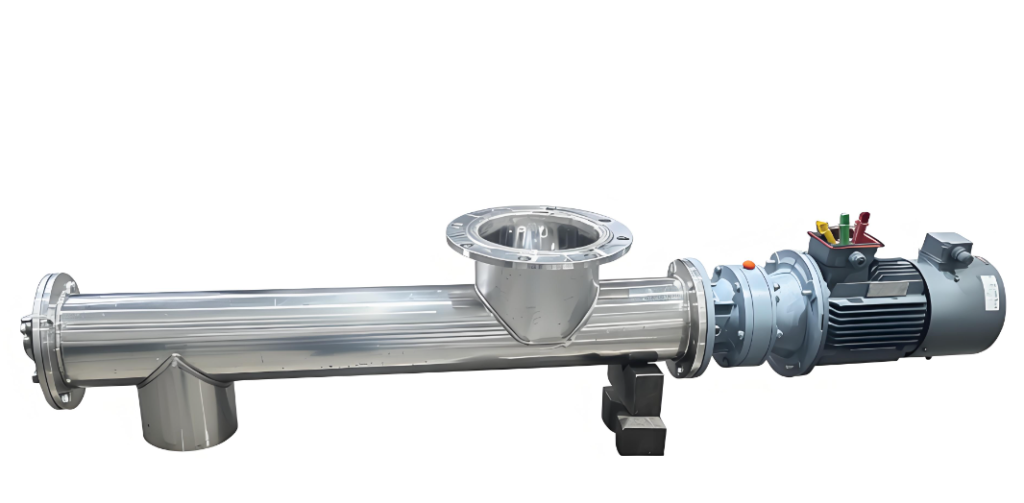
For granular materials including grains, beans, nuts and snack foods, screw conveying runs smoothly and gently, minimizing material breakage and ensuring product integrity. It can be installed horizontally or obliquely, flexibly connecting multiple processes such as washing, soaking, cooking, drying and packaging to realize continuous production line operation.
For viscous materials or those containing soft impurities, such as meat fillings, jams, bean paste and sauces, shaftless screw conveyors are more suitable. The shaftless structure is resistant to winding and clogging and easy to clean, making it ideal for processing meat products, bakery fillings and condiments. In addition, screw conveyors can be equipped with variable frequency control systems to accurately adjust conveying speed and flow rate, facilitating coordination with batching, mixing and packaging equipment to enhance production efficiency.
At present, screw conveying is widely used in grain processing, bakery products, meat products, dairy products, condiments, snack foods and other fields. It not only simplifies material transfer procedures and reduces labor costs, but also improves production hygiene and safety, making it an indispensable key equipment for automated production in the modern food industry.