
The small bag feeding station is a dust-free unpacking and unloading equipment designed for 25–50kg bagged powder and granular materials. Its core works through the coordinated operation of gravity feeding, negative pressure dust removal, and screening for impurity removal, realizing safe, clean and efficient feeding operations.
The equipment is mainly composed of a feeding platform, a quick-opening hopper, a vibrating screen, a negative pressure dust removal system, a pulse backblowing device and a control system. Before operation, start the dust removal fan first to form a stable negative pressure in the feeding cavity, where the air flows from the outside to the inside, suppressing dust overflow from the source. The operator opens the sealed feeding door, places the material bag on the grid support, cuts open the bag mouth and pours the materials; the materials fall into the hopper under the action of gravity, and the dust generated at the same time is quickly sucked into the dust removal cavity by the negative pressure air flow, avoiding diffusion into the workshop environment.
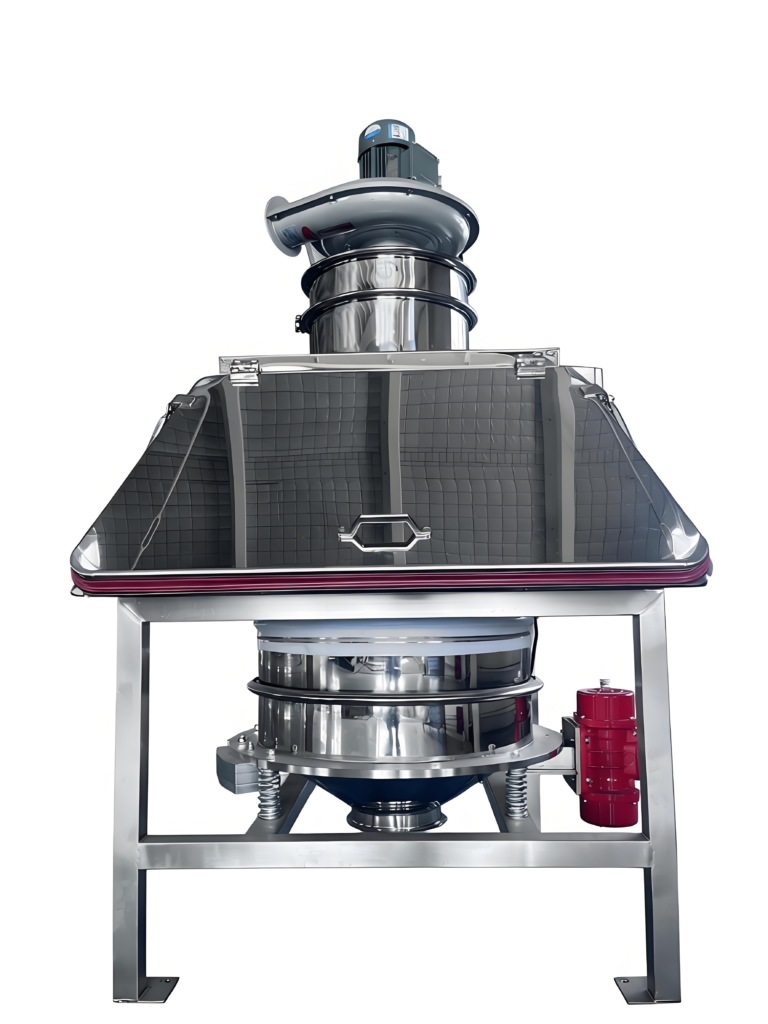
The falling materials first pass through the vibrating screen. The screen intercepts bag debris, caked materials and impurities, and the qualified powder and granules pass through the screen into the lower silo; the vibration motor assists in loosening the materials, preventing bridging and blockage, and ensuring smooth feeding. The dusty air flow enters the filter element filtering area, where the filter element intercepts more than 99% of the fine dust, and the clean air passes through the filter element and is discharged by the fan; as the dust accumulation on the filter element increases, the system automatically starts pulse backblowing, and the compressed air blows the filter element in the reverse direction. The shaken-off dust falls back into the hopper, realizing material recovery and self-cleaning of the filter element, and maintaining stable filtering efficiency.
The treated clean materials are discharged from the bottom of the silo, which can be directly connected to equipment such as vacuum feeders and screw conveyors and transported to the next process. The entire process is completed in a closed negative pressure environment, which not only protects the health of operators and reduces material loss, but also ensures the purity of raw materials through screening, adapting to the dust-free production needs of food, pharmaceutical, chemical and other industries.
