
As the core equipment for short-distance material conveying in the feed industry, screw conveyors (commonly known as augers) feature a compact structure, good airtightness and strong adaptability. They run through the entire process of raw material treatment, batching and mixing, and finished product conveying, serving as an indispensable component of modern feed production lines.
In the raw material receiving and preliminary cleaning stage, screw conveyors are applied to transport bulk powdery and granular raw materials such as corn, soybean meal and wheat bran. They are capable of horizontal, inclined and short-distance vertical conveying with a conveying capacity of up to 100 tons per hour, effectively connecting discharge pits, cleaning screens and pre-grinding silos. The fully enclosed casing prevents dust leakage, reduces material loss, improves the workshop production environment, and meets the environmental protection requirements of feed production.
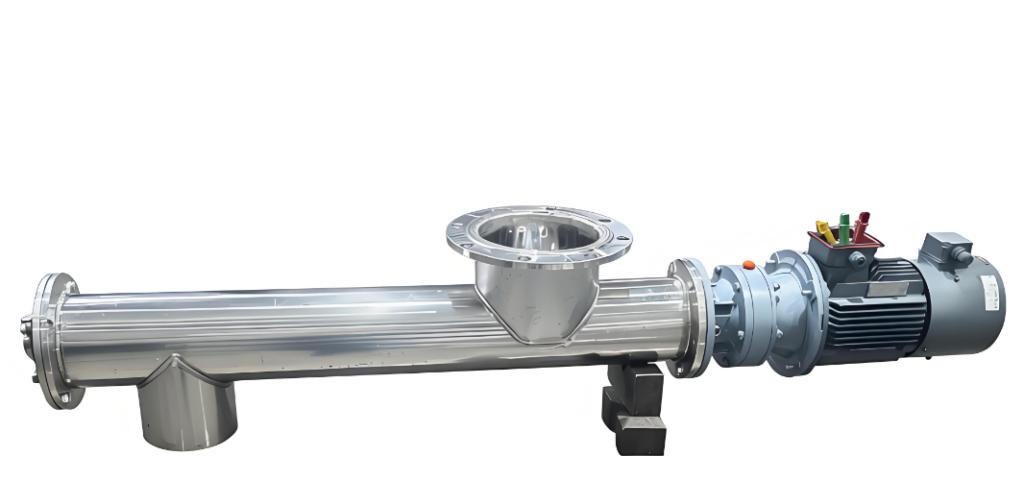
The batching and mixing section is the core application scenario of screw conveyors. Micro screw conveyors can accurately deliver additives including premixes, vitamins and minerals. Equipped with variable frequency speed regulation, they control the conveying volume with a precision deviation within ±2%, ensuring accurate feed formulas. The equipment supports multi-point feeding and multi-point discharging, enabling flexible connection with batching scales and mixers. Meanwhile, the rotating screw blades assist in preliminary material mixing and improve the uniformity of subsequent mixing procedures.
In the finished product conveying process after pelleting and extrusion, inclined screw conveyors (with an inclination angle ≤15°) are used to transport pellet feeds from coolers and dryers to packaging machines and finished product silos. Adopting thin-blade and low-speed design, they reduce pellet breakage rate and guarantee finished product quality. Made of 304 stainless steel with polished inner walls, the conveyors leave no material residue, avoid mildew and contamination, and comply with feed hygiene and safety standards.
In addition, screw conveyors adapt to intelligent production requirements. They can be integrated with level sensors, flow metering devices and PLC control systems to realize remote monitoring, automatic speed regulation and fault alarm during conveying, meeting the automated and precision production needs of intelligent feed factories. With a simple structure, easy maintenance, few wearing parts, low operating cost and short investment payback period, they are suitable for large-scale production of feed enterprises of all sizes.
In conclusion, with the core advantages of high-efficiency conveying, precise adaptation and sanitary safety, screw conveyors solve key pain points in feed production such as material transportation difficulties, dust pollution and inaccurate batching. They promote the automation and standardized upgrading of feed production, and have become vital equipment indispensable to the feed industry.