
Superhard materials (diamond, silicon carbide, corundum, etc.) are core consumables for high-end manufacturing and precision machining. Their particle size uniformity and purity directly determine product performance. As a high-precision sieving equipment for laboratories and production lines, the tap sieve features a unique compound motion mode, making it a vital device for particle classification and quality inspection of superhard materials. It is widely adopted in fine powder grading, particle size testing and product quality control.
Superhard materials bring prominent challenges to sieving: high-hardness particles tend to agglomerate, sharp particles easily block mesh holes, fine powder sieving suffers low efficiency, and high-precision scenarios impose strict requirements on particle size accuracy. The tap sieve adopts a dual-motion design combining vertical tapping and horizontal rotation, with a tapping height of about 38 mm and a tapping frequency of 156 times per minute. The high-frequency impact can break agglomerates of micron particles and continuously clean screen meshes, preventing sharp particles such as diamond and silicon carbide from jamming the holes. Its sieving efficiency is over 50% higher than ordinary vibrating sieves.
For production grading, the tap sieve is compatible with standard sieves ranging from Φ75 mm to Φ200 mm and can stack up to 7 layers of screens to accurately separate superhard fine powders of different particle sizes. Taking diamond micropowder as an example, multi-layer screen combinations can classify products of 200 mesh, 500 mesh, 1000 mesh and other specifications to meet differentiated demands for semiconductor polishing, tool sintering and other applications. Practical operation at a superhard material enterprise in Henan shows that the tap sieve operates continuously for three years without severe wear, and its repeatability of sieving data far exceeds imported equipment, suiting heavy-duty and high-frequency production conditions.
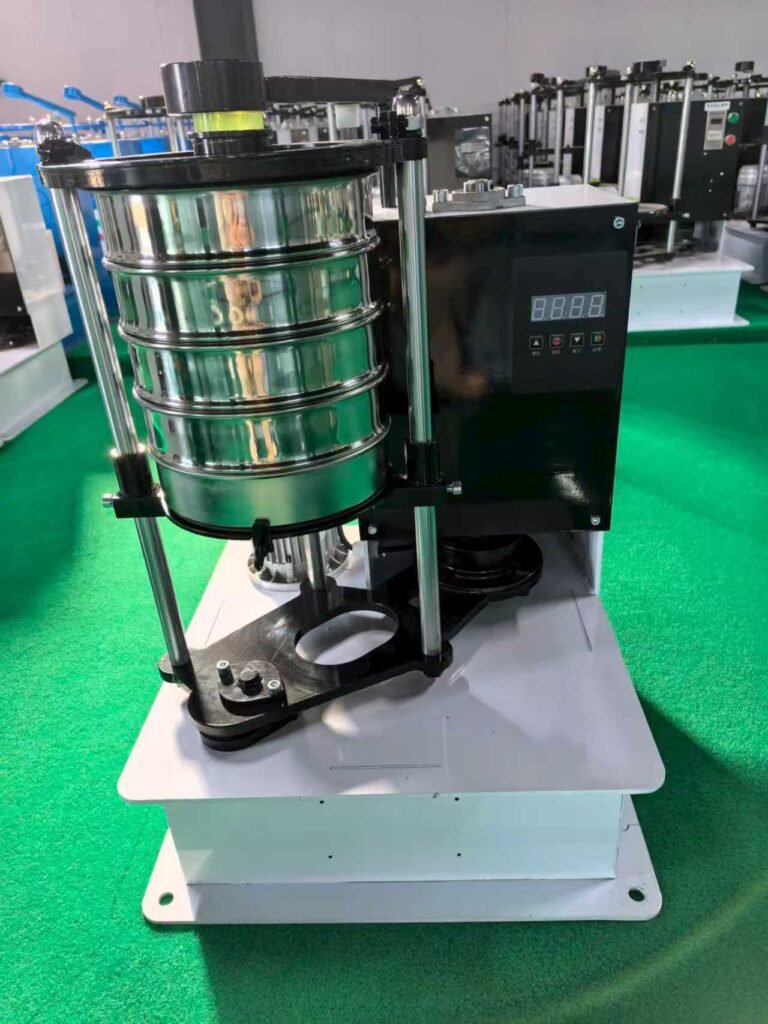
In quality inspection and R&D, the tap sieve is equipped with an intelligent timer adjustable from 1 to 99 minutes to precisely control sieving duration and guarantee consistent data across batches, providing reliable reference for formula optimization and process improvement of superhard materials. The fully enclosed structure with silicone sealing rings can be connected to dust removal units to realize dust-free sieving. It avoids environmental pollution caused by hard dust while preserving sample integrity with an extremely low loss rate.
In addition, double-unit tap sieves can process two samples simultaneously to boost inspection and R&D efficiency, catering to parallel tests and comparative analysis in superhard material manufacturers. Featuring robust construction, simple operation and low maintenance costs, it satisfies small-batch laboratory testing as well as mass grading on production lines, standing out as a cost-effective sieving solution for the superhard material sector.
In conclusion, with targeted structural design, tap sieves tackle the core sieving difficulties of superhard materials while delivering high precision, high efficiency and outstanding stability. Covering the full workflow of R&D, production and quality testing for superhard materials, they deliver crucial support for product quality improvement and industrial upgrading in the sector.