
In chemical production, raw materials in powder and granular form packed in 25–50 kg small bags (such as pigments, dyes, additives, fillers, etc.) are traditionally unpacked manually in open environments during feeding. This easily leads to dust emission, material loss, potential safety hazards and environmental pollution. As a special airtight and dust-free unit, the small bag dumping station has become core equipment for pre-processing solid raw materials in the chemical industry, widely adopted in fine chemicals, coatings, rubber & plastics, pesticides and other sectors.
The small bag dumping station consists of feeding module, negative pressure dust removal module, sieving module, conveying connection module and intelligent control module. During operation, workers place small bags on the feeding platform and cut open the packaging bags inside the sealed chamber, allowing materials to fall onto the screen mesh. Qualified materials pass through the sieve and flow to downstream equipment, while foreign impurities and empty bags are retained. The negative pressure system captures dust in real time, and clean air is discharged after filtration by filter cartridges, achieving zero dust leakage. The equipment can be connected to vacuum loaders, screw conveyors and other devices to realize closed conveying, suitable for handling corrosive, irritant, toxic and flammable materials.
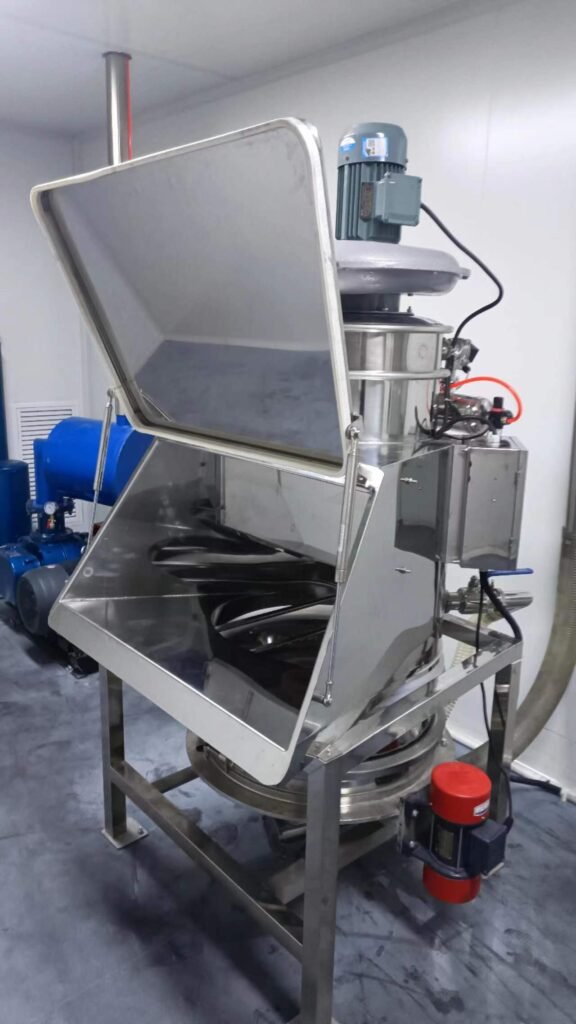
It delivers remarkable core values in chemical production. First, it ensures safety and environmental protection to protect workers’ health. Most chemical materials are corrosive, toxic or irritant. The station is made of corrosion-resistant 316 stainless steel or plastic-lined materials with chemically resistant seals to avoid contact corrosion damage. The closed negative pressure design prevents diffusion of toxic dust and odors, complies with environmental and occupational health standards, and eliminates explosion risks. Second, it stabilizes product quality and cuts material loss. The built-in vibrating screen intercepts agglomerates and impurities to guarantee raw material purity and avoid finished product defects. The sealed working space reduces dust loss by 3% to 8% according to statistics, and prevents external contaminants from mixing in, ensuring consistent batch quality. Third, it features high efficiency and low energy consumption to fit flexible production. With compact footprint and simple operation, only one or two operators can finish the whole process of unpacking, feeding and sieving, greatly reducing labor intensity. It runs at low power with minimal energy consumption. Optional accessories including vibrating hoppers, air hammers and magnetic separators can be configured to suit materials with different fluidity and particle sizes, meeting flexible production requirements of multiple varieties and small batches.
In addition, the small bag dumping station can be integrated with a PLC control system to realize automatic linkage of feeding, dust removal and conveying, supporting digital transformation of chemical enterprises. It efficiently addresses common feeding pain points in scenarios such as processing titanium dioxide and carbon black in coating production, handling color powder in dye manufacturing, and feeding PVC powder in plastics industry.
In conclusion, with advantages of dust-tight sealing, safe corrosion resistance, high efficiency and low consumption as well as flexible adaptability, small bag dumping stations thoroughly resolve feeding difficulties of small-bag chemical materials. They provide vital support for green, safe and high-efficiency chemical production, boasting broad application prospects.