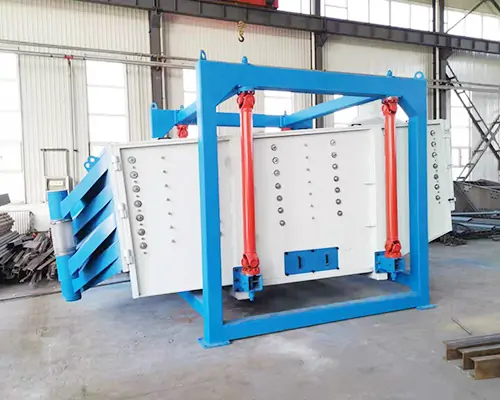
As a high-precision laboratory sieving equipment, the tap sieve features combined vibration and tapping motion. It has become the core device for particle size testing, classification and quality control in the abrasives and superhard materials industry, and is widely used in the production and R&D of materials such as diamond and silicon carbide, white fused alumina.
Abrasives and superhard materials including diamond powder, silicon carbide and white fused alumina are characterized by high hardness, easy agglomeration of fine powder and strict requirements on particle size accuracy. Traditional vibrating sieves are prone to mesh clogging and low sieving efficiency, which fail to meet production requirements. Driven by the motor, the tap sieve generates horizontal circular vibration and high-frequency vertical tapping to form a three-dimensional sieving track. It can effectively disperse micron-sized particles agglomerated by static electricity and van der Waals force, and clear blocked mesh through tapping impact. Its sieving efficiency is over 50% higher than that of conventional equipment, perfectly solving the sieving difficulties of high-hardness materials.
In the conventional abrasives sector, tap sieves are mainly applied to particle size inspection and classification of white fused alumina, brown fused alumina and emery. As a high-end abrasive material, the particle size distribution of white fused alumina directly determines polishing precision and workpiece surface finish. Equipped with φ200 standard test sieves, the tap sieve accurately separates particles of 20 to 500 meshes, strictly controls particle size deviation and ensures batch consistency, providing reliable data for abrasive grade evaluation.
For superhard materials, tap sieves serve as key equipment for grading diamond and cubic boron nitride. Widely used in semiconductor polishing and tool manufacturing, these materials demand extremely high particle size purity. Even a tiny amount of coarse particles will lead to product rejection. The compound motion of the tap sieve improves the penetration rate of difficult-to-sieve critical particles. With precise timing control, it thoroughly separates particles of different sizes and avoids mixing of coarse grains. Its fully enclosed structure matched with dust removal devices realizes dust-free sieving, preventing hard dust pollution and sample loss, and guaranteeing the purity and quality of superhard materials.
In addition, the tap sieve features compact structure and simple operation. It is compatible with test sieves of φ75, φ100, φ200 and other specifications, with flexible clamping and automatic shutdown function, greatly reducing human errors. It is a standard configuration for enterprise quality inspection, and also applied to analyze particle size characteristics of new superhard materials in R&D, supporting process optimization.
In conclusion, with the advantages of high efficiency, precise classification, anti-clogging and dust-free operation, the tap sieve addresses the core sieving problems of abrasives and superhard materials. As a vital link between production and quality inspection, it drives the industry toward higher precision and quality.